Evaluating the Hiring and Job Vacancy Social Media Post Template for Your Business
In the competitive landscape of talent acquisition, the way you present a job opening can significantly influence the caliber and volume of applicants. A Hiring and Job Vacancy Social Media Post serves as a pre-designed visual template specifically crafted for announcing employment opportunities across social media platforms like LinkedIn, Instagram, Facebook, and Twitter. These templates typically include placeholders for job titles, company names, key responsibilities, qualifications, and call-to-action buttons, all wrapped in a professional aesthetic that aligns with brand identity. The product in question here is a Creative Professional Hiring and Job Vacancy Social Media Post that comes as an Adobe Illustrator file set, offering customization at a basic skill level. This article evaluates whether such a template is the right choice for your recruitment marketing needs, examining benefits, tradeoffs, and practical decision-making factors.
Understanding the Hiring and Job Vacancy Social Media Post Template
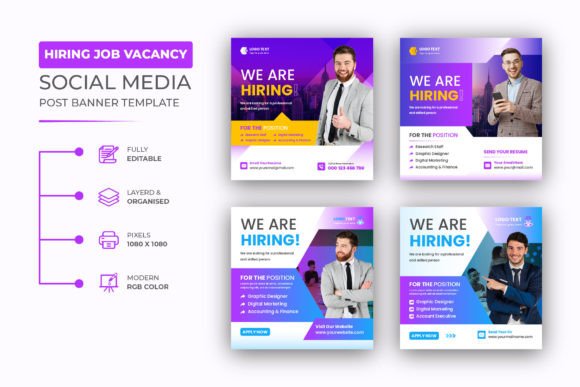
A Hiring and Job Vacancy Social Media Post is more than just a digital flyer. It is a structured communication tool that combines graphic design principles with recruitment messaging. The product includes four AI EPS files at 72 DPI resolution, each sized at 1080x1080 pixels — the standard square format for most social feeds. The RGB color mode ensures vibrant display on screens, and the inclusion of a help guide and free font links reduces setup friction. The template is built in Adobe Illustrator CC, meaning users need at least a basic familiarity with the software to replace placeholder text, adjust colors, swap images, and modify layout elements. The expectation is that anyone with rudimentary Illustrator skills can adapt the design to fit their brand without needing a professional designer.
Why Consider a Pre-Made Social Media Post for Job Vacancies?
Organizations of all sizes regularly face the challenge of making job postings stand out in crowded social feeds. A dedicated Hiring and Job Vacancy Social Media Post template addresses several pain points. First, it saves time. Instead of starting from scratch with each new vacancy, a template provides a consistent framework that can be duplicated and edited rapidly. Second, it ensures visual coherence across multiple postings, reinforcing brand recognition. Third, it lowers the barrier to professional-looking design for teams without in-house graphic design resources. For small businesses, startups, or HR departments with limited budgets, a one-time purchase of such a template can replace the need for ongoing design subscriptions or freelance costs.
Another reason for interest lies in the specific file format. AI and EPS files are vector-based, meaning they scale cleanly and allow for deep customization. Unlike simpler tools like Canva templates, which offer limited control over layers, gradients, and typography, an Illustrator template gives the user full creative freedom once they understand the basics. This makes it a suitable choice for those who already work within the Adobe ecosystem or who plan to maintain a library of editable recruitment assets.
Key Benefits of Using a Hiring and Job Vacancy Social Media Post
When evaluating a Hiring and Job Vacancy Social Media Post, several advantages emerge. The template promises easy customization — changing text, colors, and images is straightforward if you know basic Illustrator operations like selecting layers, using the Type tool, and applying swatches. The 1080x1080 pixel dimension is optimal for most social platforms, ensuring the post displays without cropping or distortion. The inclusion of four separate AI EPS files means you can create variations — perhaps one for general openings, one for executive roles, one for internship programs, and one for urgent hires — all sharing a consistent design system.
Additionally, the 72 DPI resolution is standard for screen use, so the file size remains manageable and uploads quickly. The RGB color mode ensures that colors appear as intended on digital displays, which is critical for brand accuracy. The free font links are a practical touch — many premium fonts would otherwise require separate licensing, increasing hidden costs. The help guide further reduces the learning curve, making the template accessible to non-designers who are willing to invest a small amount of time in learning.
Tradeoffs and Considerations to Keep in Mind
No product is without limitations, and the Hiring and Job Vacancy Social Media Post template has several tradeoffs that a potential buyer should weigh carefully. The most significant is the dependency on Adobe Illustrator. If your team does not have access to Illustrator CC, or if no one on staff is comfortable with it, the template becomes unusable without additional software purchase or training. While the product page states that only basic Illustrator knowledge is needed, that still assumes a baseline understanding of layers, paths, text boxes, and exporting. For users who exclusively work with web-based design tools or mobile apps, this template will not be a natural fit.
Another consideration is resolution. 72 DPI is standard for web, but if you ever need to print the post — for a physical job fair poster, a window display, or a printed handout — the resolution may appear pixelated. Similarly, the 1080x1080 pixel size is fixed; while it works well for social media, it does not adapt to other formats like Instagram Stories (1080x1920) or LinkedIn banner images (1584x396). If your recruitment strategy spans multiple platforms with varying aspect ratios, you would need to either create additional versions manually or look for a more flexible template system.
There is also the question of originality. Pre-made templates, by nature, are sold to multiple buyers. While you can customize colors and fonts to match your brand, the overall layout and composition may resemble posts from other organizations using the same template. For companies that prioritize highly distinctive or avant-garde visual identities, a template may feel too generic. However, for most small to mid-sized businesses, the consistency and professionalism gained far outweigh the risk of visual similarity.
Situations Where This Template is a Strong Fit
A Hiring and Job Vacancy Social Media Post template proves most valuable in specific contexts. Consider a growing retail chain that posts new store openings and seasonal hiring every month. Having a reusable template allows the HR team to maintain a steady cadence of job announcements without reinventing the design wheel each time. Similarly, a nonprofit organization with a small communications staff can use the template to quickly announce volunteer roles or paid positions, freeing up time for other mission-critical tasks.
Another strong use case is for recruitment agencies that manage high volumes of job listings across multiple clients. The four-file variation capacity enables them to create distinct visual families for different client industries — such as healthcare, technology, and hospitality — while keeping each set cohesive. Freelance recruiters or independent HR consultants also benefit from the professional finish that a template provides, especially when they need to present a polished image without investing in advanced design skills.
For companies that already use Adobe Illustrator for other design needs — such as creating social media graphics, presentations, or marketing collateral — adding a recruitment-specific template to their library is a low-effort way to extend the same visual language to hiring communications. The learning curve is minimal if the user already knows how to work with AI files, replace linked images, and manage text overflows.
When Alternatives Might Be Worth Considering
While the template offers solid value for many, there are scenarios where alternative approaches may serve you better. If your organization does not have or does not plan to subscribe to Adobe Illustrator CC, the upfront cost of the software (even on a monthly plan) can be significant relative to the template price. In that case, a browser-based design tool like Canva or Crello might be more practical. Many such platforms offer free and premium templates for job postings that can be edited directly in a web browser, with no additional software required. They also provide the flexibility to export in multiple sizes and formats, which this Illustrator template does not.
Another alternative is to invest in a comprehensive recruitment marketing platform that integrates with your applicant tracking system (ATS) and allows you to generate branded posts automatically. These solutions often include dynamic text replacement, scheduling, and analytics, but they come with a recurring subscription cost that may be hard to justify if you only post a few vacancies per year.
If your brand requires extremely tailored visuals — such as custom illustrations, photography, or complex infographics — a professional graphic designer may be a better long-term investment. A designer can create a unique layout that aligns perfectly with your brand guidelines, and can provide source files in multiple formats (including InDesign, Sketch, or Figma) that suit your workflow better than AI or EPS files.
Additionally, if you need to post vacancies in languages other than English, or if your audience expects specific cultural visual cues (like local colors, symbols, or typography), the template’s default design may require substantial reworking. While customization is possible, it may negate the time-saving benefit of using a pre-made layout.
Practical Decision-Making Insights
To determine whether a Hiring and Job Vacancy Social Media Post template aligns with your goals, start by auditing your current recruitment workflow. Ask yourself: How many job postings do you create per month? Who is responsible for designing them? What tools do they currently use? How much time is spent on each post? If the answer involves frequent reuse of a similar layout and your team already has Illustrator access, the template is likely a cost-effective and time-efficient solution.
Next, consider the balance between consistency and freshness. A template ensures that every job posting looks like it belongs to your brand, but if you post very frequently — say, multiple times a week — audiences may experience visual fatigue. In that case, you might want the four files to represent different layouts rather than just color variations, so you can rotate between designs while maintaining brand identity.
Also evaluate the level of support you might need. The product page mentions that the seller can be contacted for help with the file or special customization. This is a practical safety net for users who are still building their Illustrator skills. However, response times are not guaranteed, so if you have a time-sensitive posting, it is wise to test the template well in advance of your deadline.
Finally, consider the long-term return on investment. A template purchased once can be reused indefinitely for any number of job vacancies, making it far cheaper than paying for individual designs or a monthly subscription. Even if you only hire a few times a year, the template pays for itself after one or two uses compared to freelance design costs. The key is to ensure that the template’s format and resolution continue to meet your needs as platforms evolve. Since 1080x1080 pixels remain the standard for feed posts on Instagram, Facebook, and LinkedIn, this format is likely to stay relevant for the foreseeable future.
Final Thoughts on Choosing a Hiring and Job Vacancy Social Media Post
A Hiring and Job Vacancy Social Media Post template offers a practical middle ground between hiring a professional designer and posting plain text updates. It empowers teams without design backgrounds to produce visually consistent, brand-aligned job announcements quickly and affordably. The tradeoffs — dependence on Adobe Illustrator, fixed resolution and size, and potential for generic appearance — are real but manageable for most small to medium-sized organizations. By honestly assessing your team’s skills, tools, and volume of hiring needs, you can decide whether this template is a valuable addition to your recruitment toolkit or whether an alternative approach better suits your context. Regardless of which path you choose, prioritizing clear, professional, and consistent job vacancy communications will strengthen your employer brand and attract better candidates over time.