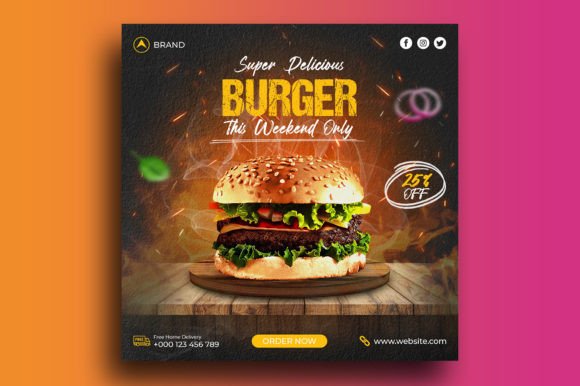
Burger and Food Menu Social Media Post Template: A Practical Guide for Restaurants
When you run a restaurant, café, or food business, your social media presence is often the first impression a potential customer gets. A well-crafted menu post can spark cravings, drive foot traffic, and build brand recognition. But not every restaurant owner has the time, budget, or design expertise to create polished visuals from scratch. That is where a Burger and Food Menu Social Media Post template enters the picture. These pre-built PSD files are designed to let you produce professional-looking posts with minimal effort. This article evaluates what these templates offer, explores their strengths and limitations, and helps you decide whether they align with your marketing needs.
What Is a Burger and Food Menu Social Media Post Template?
A Burger and Food Menu Social Media Post template is a layered Photoshop (PSD) file built specifically for promoting food menus on social media platforms. It typically includes placeholders for your own images, text layers for menu items and prices, and a design optimized for a 1080 by 1080 pixel square format. The template mentioned here comes with features such as 300 DPI resolution, RGB color mode, and free font usage. It is intended to be easy to edit even if you only have basic Photoshop skills. The download includes one PSD file, but stock images are not included, so you will need to supply your own food photography or graphics.
These templates are not custom designs made for a single brand. Instead, they are reusable starting points that you adapt for each new menu item or promotion. Because the layout, colors, and typography are already set, you can focus on swapping out the image and updating the text rather than building a composition from the ground up.
Why Consider Using a Pre-Made Template?
Many restaurant owners and social media managers face a common challenge: they need to post regularly, but they lack dedicated design resources. A Burger and Food Menu Social Media Post template addresses this gap by offering repeatable consistency. You can maintain a uniform look across your feed without having to reinvent the visual approach each time. This consistency helps customers recognize your posts instantly as they scroll through their feed.
Another reason to consider a template is speed. When you have a new burger special or a limited-time combo, you want to get the word out quickly. Instead of waiting for a designer to create a layout from scratch, you can open the PSD, drop in your photo, update the burger name and price, and export a post-ready image in a matter of minutes. For small teams or solo operators, that time saving is valuable.
Cost is also a factor. Hiring a graphic designer for every social media post can add up quickly. A single template purchase gives you a reusable foundation. While it is not a substitute for a full brand identity package, it is a budget-friendly way to produce visuals that look intentional and polished.
Key Benefits and Practical Tradeoffs
Understanding the benefits of a Burger and Food Menu Social Media Post template means also understanding its limitations. Let's look at both sides so you can make an informed choice.
Benefits
- Ease of editing: The template is built for users who know the basics of Photoshop. You do not need advanced skills to change the text or swap an image. Most layers are clearly labeled, and the file is organized to reduce confusion.
- Optimized resolution and color: At 300 DPI and using RGB color mode, the template is set up for digital display. This means your posts will look sharp on screens, whether viewed on a phone, tablet, or desktop monitor.
- Square format: The 1080 by 1080 pixel size is a standard on Instagram, Facebook, and other social platforms. This eliminates the guesswork of cropping or resizing for the most common post format.
- Free font compatibility: The template uses free fonts, so you do not have to purchase expensive typefaces to match the design. You can download the fonts without additional cost, which keeps your expenses low.
Tradeoffs and Considerations
- Images are not included: You must supply your own food photography. If you do not have high-quality images of your burgers or menu items, the final result may not look as professional as you hope. Stock food photos are an option, but they may not accurately represent your actual dishes.
- One PSD file: You receive a single file with one layout. If you want multiple variations (different color schemes, different arrangements, or vertical formats for Stories), you will need to customize further or purchase additional templates.
- Limited uniqueness: Because templates are available to many users, there is a chance that other food businesses could use the same or a similar design. If brand differentiation is critical to you, a template may not provide enough distinctiveness without significant modifications.
- Photoshop requirement: The template is a PSD file, so you need Adobe Photoshop to edit it. If you do not already have a subscription, that is an added cost. Alternatives like free photo editing software may not support PSD layers fully.
When Is This Template a Strong Fit?
A Burger and Food Menu Social Media Post template works best in specific situations. Recognizing these scenarios can help you decide if it is right for you.
- Small restaurants and food trucks: If you have a limited menu and a small marketing budget, a template gives you a repeatable system. You can create posts for each menu item without needing a designer on retainer.
- Social media managers with multiple clients: If you manage accounts for several food businesses, a template can serve as a baseline that you adapt quickly. The familiarity of the file structure saves time when you are juggling many posts.
- Launching a new menu item: When you introduce a new burger or seasonal special, speed matters. A template lets you produce a promotion post the same day the item becomes available.
- Building feed consistency: If your current social media feed looks inconsistent because each post uses a different layout or color scheme, sticking with one template can create a cohesive visual identity over time.
When Alternatives May Be Worth Considering
Templates are not a universal solution. In some situations, you might be better served by a different approach.
- Established brands with a strong identity: If your restaurant already has a well-defined brand with custom colors, typography, and photography, a generic template may clash with your existing assets. In this case, hiring a designer to create a custom social media kit aligned with your brand guidelines is a better investment.
- Need for multiple formats: A single square template is useful, but social media now requires Stories (vertical), reels, and sometimes landscape images for other platforms. If you need a full set of assets in different aspect ratios, a single PSD template may not be efficient. You might need a bundle or a custom solution.
- High volume of posts: If you post multiple times per day across several accounts, manually editing a PSD for every post can become tedious. In that case, a social media management tool with built-in design capabilities or a dedicated design resource may be more practical.
- No access to Photoshop: Without Photoshop, the PSD file is not usable. Alternatives like Canva or Adobe Express offer browser-based templates that do not require software installation. These platforms also provide food menu templates, though they may not have the same resolution or layer control.
Practical Decision-Making Insights
As you evaluate whether a Burger and Food Menu Social Media Post template aligns with your goals, consider a few practical factors.
Assess your own photography. The template is only as good as the image you place into it. If you have a camera or smartphone that can take appetizing, well-lit photos of your food, you are in a strong position. If not, factor in the time or expense of improving your food photography before committing to a template-based workflow.
Think about long-term consistency. Using the same template repeatedly can create a recognizable look, but it can also become monotonous. Decide in advance how you will handle variations. You might use the template for core menu items and create separate, more casual posts for daily specials or behind-the-scenes content. Balance is key.
Consider scalability. If your business grows and you begin working with a dedicated marketing team, the template may become a bottleneck. A designer can rework it to fit a larger content strategy, or you might outgrow it entirely. That is fine; a template is often a stepping-stone, not a permanent solution.
Test the editing process. Before you rely on the template for a campaign, open it in Photoshop and walk through the steps of changing the image, updating the text, and exporting. This trial run will reveal any pain points. If the layers are not intuitive or the fonts do not render correctly, you will know early and can decide whether to proceed or look for a different template.
Aligning the Template with Your Goals
Ultimately, a Burger and Food Menu Social Media Post template is a tool. Its value depends on how well it matches your current needs, your technical comfort level, and your brand expectations. For a small restaurant owner who wants to post menu updates twice a week without hiring a designer, this type of template is a practical and cost-effective solution. For a larger chain with strict brand guidelines and a dedicated creative team, a custom approach will likely serve better.
The key is to evaluate the template not on its features alone, but on how it fits into your actual workflow. Ask yourself: Will this save me time? Will it help me post more consistently? Do I have the images and software needed to use it effectively? If the answers are yes, then the template is worth trying. If you find yourself fighting the design or wishing it did more, then exploring alternative templates, design platforms, or professional services might be the right move.
No single resource solves every content need. But a well-designed, easy-to-edit template can remove a significant barrier to entry for food businesses that want to maintain an active and visually appealing social media presence. By weighing the benefits against the tradeoffs and considering your specific context, you can make a decision that supports your marketing goals without overcomplicating your process.